Cnut the Great by Timothy Bolton
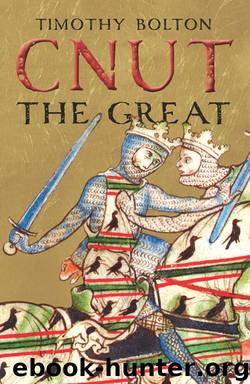
Author:Timothy Bolton
Language: eng
Format: epub
ISBN: 9780300208337
Publisher: Yale University Press
Published: 2017-05-29T16:00:00+00:00
Chapter 4
THE RISE TO DOMINANCE OVER
SCANDINAVIA
The actions of Cnut following the sudden death of his elder brother, Harald, around 1019, speak volumes about Cnut’s feelings towards his homeland. Many modern English historians have preferred to see him as a convert to English culture, and because the wealth of his English realm far exceeded that of contemporary Denmark it must have seemed a very attractive prize.1 Moreover, Cnut’s dynasty were only recent arrivals in Denmark and his main opportunities for advancement until his brother’s death had been in England. However, on the death of Harald, Cnut readily accepted the hornet’s nest that was rule of a Scandinavian country, and both defended this realm and used English resources to extend his grasp over it. It is perhaps worth contemplating that he could have focused on his acquisition, and left Denmark to its own fate. England may have been of crucial importance to him, but he seems to have remained at heart a Scandinavian.
Before moving on to Cnut, we should say a few words about Harald. Like many members of an important dynasty who die young, Harald is a shadowy figure of whom few, if any, facts are known with certainty. We are therefore forced to trace what little is known of his life from a brief range of sources, none of which gives an impartial picture. We know from the Encomium that he remained in control of Denmark when Cnut left to reinvade England in 1015.2 Harald was certainly alive in 1017×1019 when his name was entered after Cnut’s in a note of confraternity in a Christ Church, Canterbury, Gospel Book, but this does not mean he was in England and Harald may just have been included as the only other senior living male member of Cnut’s dynasty.3 The mid-thirteenth-century Danish Annales Ryenses relates a complex story which claims that Harald was deposed for being ‘effeminate’ (effeminatus) and completely dedicated to lusts or pleasures in favour of Cnut, then Cnut was rejected due to his absence in England, and finally restored after Harald’s death.4 Campbell calls this ‘absurd’.5 However, it is our only source, and it is not so incredible that Harald suffered a period of unpopularity during Cnut’s time in England (either in 1013–14 or more credibly 1015–20).6 Here the term effeminacy may not indicate anything about Harald’s gender orientation or sexual persuasion. It is used in the sense of a homosexual in the Vulgate Bible, but appears in other contexts in the Middle Ages, most commonly to describe a failure to hold oneself in check, or to maintain control.7
It has long been surmised, probably quite rightly, that when the Anglo-Saxon Chronicle notes that in 1019 Cnut went to Denmark ‘with nine ships and dwelt there all winter’, it was to receive the royal title there following his brother’s recent death.8 Cnut’s letter to the English of 1019–20 states that he had travelled to Denmark ‘from where the most harm came to you; and then with God’s help have taken a
Download
This site does not store any files on its server. We only index and link to content provided by other sites. Please contact the content providers to delete copyright contents if any and email us, we'll remove relevant links or contents immediately.
| Africa | Americas |
| Arctic & Antarctica | Asia |
| Australia & Oceania | Europe |
| Middle East | Russia |
| United States | World |
| Ancient Civilizations | Military |
| Historical Study & Educational Resources |
Room 212 by Kate Stewart(5139)
The Crown by Robert Lacey(4828)
Endurance: Shackleton's Incredible Voyage by Alfred Lansing(4797)
The Iron Duke by The Iron Duke(4373)
The Rape of Nanking by Iris Chang(4231)
Joan of Arc by Mary Gordon(4125)
Killing England by Bill O'Reilly(4016)
Say Nothing by Patrick Radden Keefe(3997)
I'll Give You the Sun by Jandy Nelson(3459)
Shadow of Night by Deborah Harkness(3385)
Hitler's Monsters by Eric Kurlander(3363)
Mary, Queen of Scots, and the Murder of Lord Darnley by Alison Weir(3222)
Blood and Sand by Alex Von Tunzelmann(3212)
Eleanor & Park by Rainbow Rowell(3196)
Darkest Hour by Anthony McCarten(3143)
Margaret Thatcher: The Autobiography by Thatcher Margaret(3093)
Book of Life by Deborah Harkness(2952)
Red Famine: Stalin's War on Ukraine by Anne Applebaum(2948)
The One Memory of Flora Banks by Emily Barr(2875)
